
This article is written by Rinmayee Khobragade
INTRODUCTION
In today’s era of rising use of social media, your creative work can be copied, shared, and distributed without your consent within minutes, making misappropriation and unauthorised use alarmingly easy with a click of a finger. That is why safeguarding your intellectual property is no longer optional; it is essential. This is where copyright protection plays a significant role.
In India, copyright automatically subsists the moment an original work is created in tangible form, while not mandatory, it is a strong procedure tool, registration of the same provides you with certification of ownership, serves as prima facie evidence in legal proceedings, enforce rights, prevent infringement, provides economic opportunities, protects the authors work for lifetime plus 60 years, etc. It also provides protection not only within India but also in other member countries of the Berne Convention.
As per section 14 of the Copyright Act 1957, “copyright” refers to the exclusive right that grants ownership and control of the creative work. It includes the right to reproduce, issue copies, perform or communicate the work in public, translate, make any adaptation, sell or commercially rent.
What can be protected under copyright?
Before you start filing for copyright, it is important to understand what is protected under copyright act. As per section 13 of the act, Copyright subsists throughout India in the following classes of works:
- Original literary, dramatic, musical and artistic works;
- Cinematograph films; and
- Sound recordings.
Originality in copyright law means that a work must be created independently, without copying, and must display at least a minimal level of creativity or skill, but mere ideas or concepts in your mind are not eligible for protection, as anyone can think, imagine, or come up with concepts, hence the expression of these ideas in a tangible form is important for protection.
Certain works are excluded from copyright protection. Such as Official texts, statutes, judicial decisions, and government publications. There are also certain limitations to copyright, like doctrines of fair use, which allow the use of copyrighted material for purposes like private study, education, and research.
STEP BY STEP PROCEDURE FOR REGISTRATION OF COPYRIGHT IN INDIA
The copyright registration process in India is governed by the Copyright Act 1957. The process has been made online in recent years, making it easily accessible. It is also user-friendly and convenient to use.
The filing process is divided in four part,
- Filling of Form XVI
- Statement of Particulars
- Statement of further Particulars
- Payment
STEP 1. New User Registration Sign up
First and foremost, If you are a new user, you will have to register yourself on copyright.gov.in, this step is self explanatory.
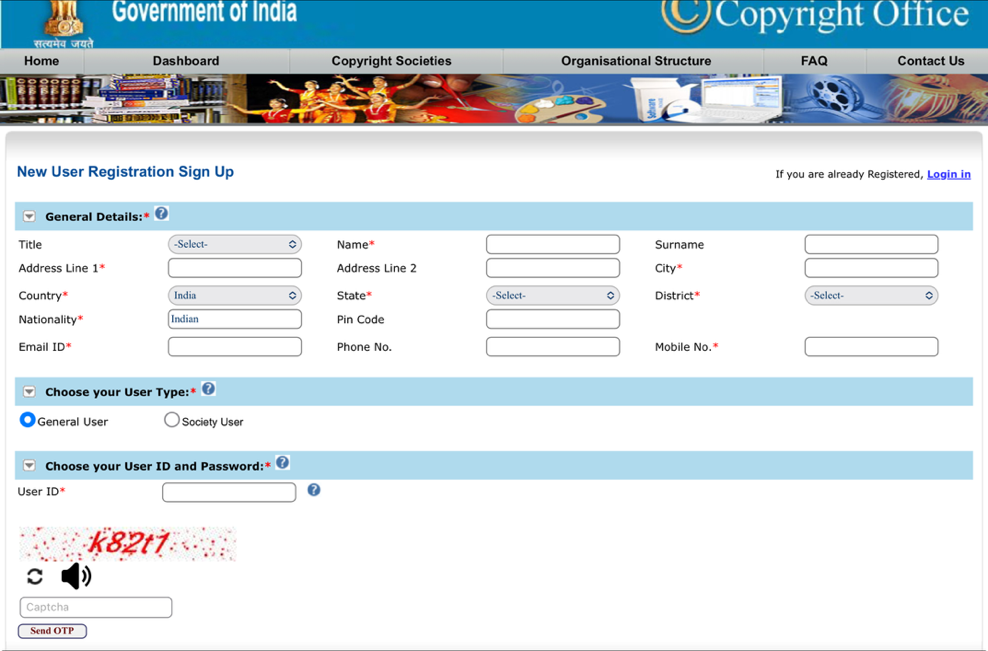
After you are done with the registration, log in and click on “e-filling of application”
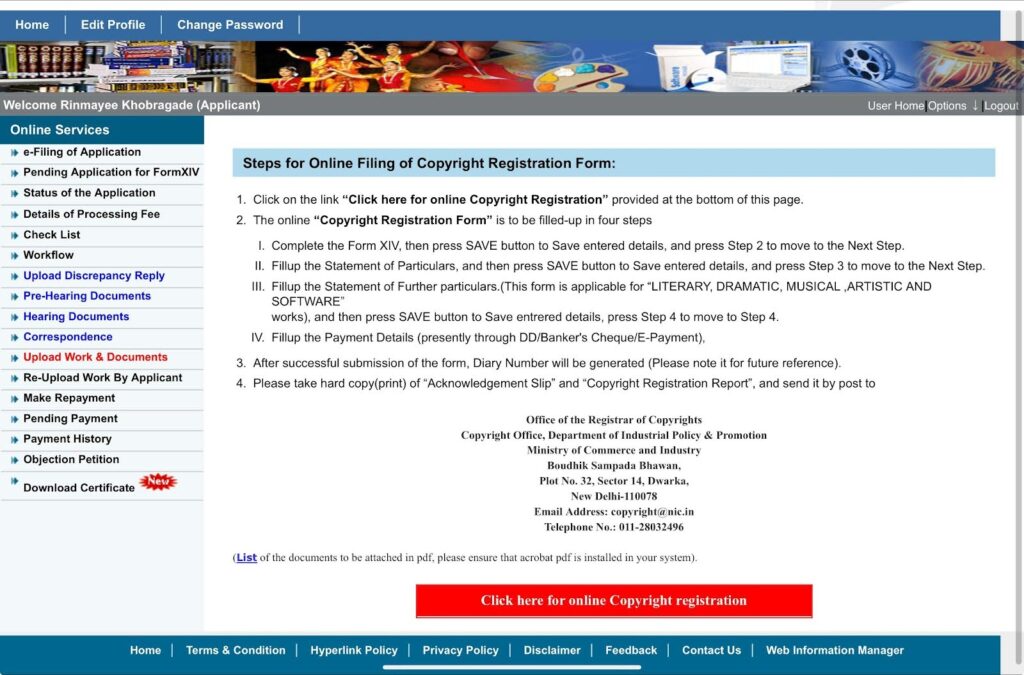
STEP 2. Filling of form XVI
The application is made under Section 45 of the Copyright Act, 1957.
Section 1 – You must attach the Statement of Further Particulars, which provides detailed information about your work (especially for literary, dramatic, musical, or artistic works). This will be done in detail in Statement of Particulars.
Section 2 – This requires you to send a copy of your application (Form XIV, Statement of Particulars, Statement of Further Particulars) by registered post to any person who might have an interest in or claim over the work. You must provide the recipient’s name, nationality, address, pincode, and date of dispatch here.
Section 3 – You provide the contact details (name, address, pincode, phone) for correspondence from the Copyright Office.
Section 4 – You declare that, to the best of your knowledge, no one else has a valid claim or interest in the work (other than those notified in Section 2).
Section 5 –You confirm that all details provided in Form XIV, Statement of Particulars, and Statement of Further Particulars are true and complete.
You tick “I Accept” to agree to the declarations and verifications before proceeding to the next step in the online filing process.
STEP 3. Statement of Particulars
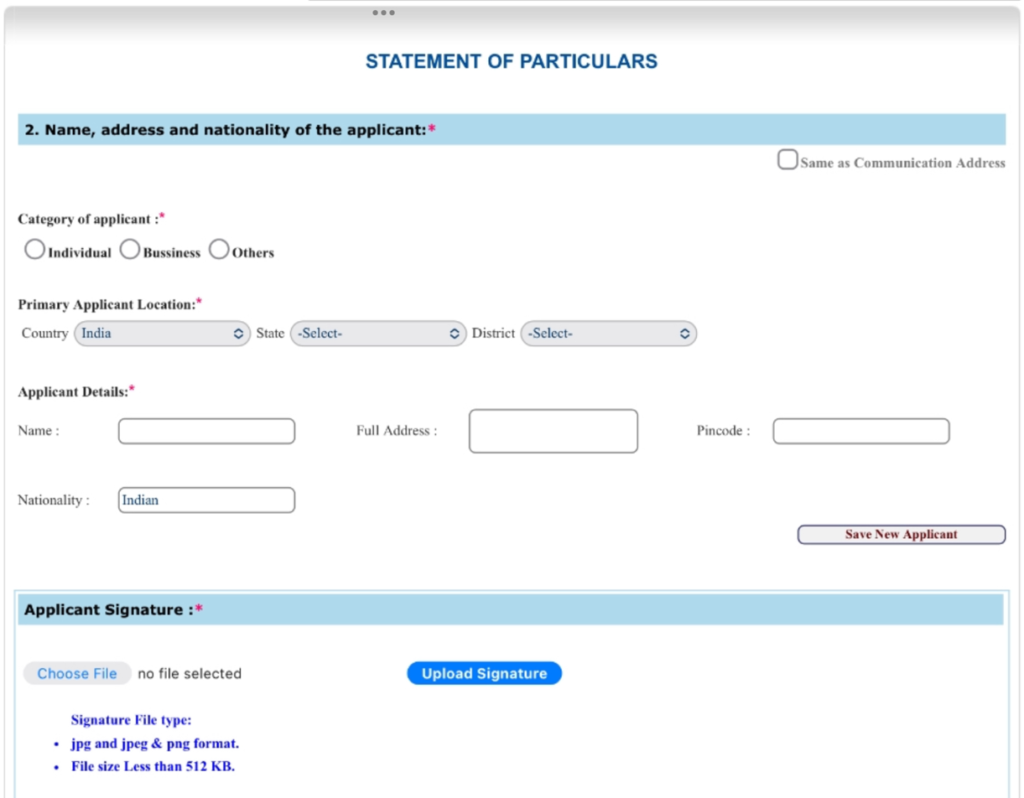
This Statement of Particulars form is basically the detailed profile of your copyright application — it records who you are, what the work is, who created it, and who owns the rights.
Section 2 – Applicant’s Details
This is all about you (the person or organisation applying).
- Category of applicant – Select if you are:
- Individual, i.e a single person
- Business: if you are a registered company, partnership, etc, filing for copyright
- Others, if you are filing copyright for a trust, society, NGO, etc.
- Location – Country, State, District where you are based.
- Your details such as your Name, Postal address, pin-code and nationality.
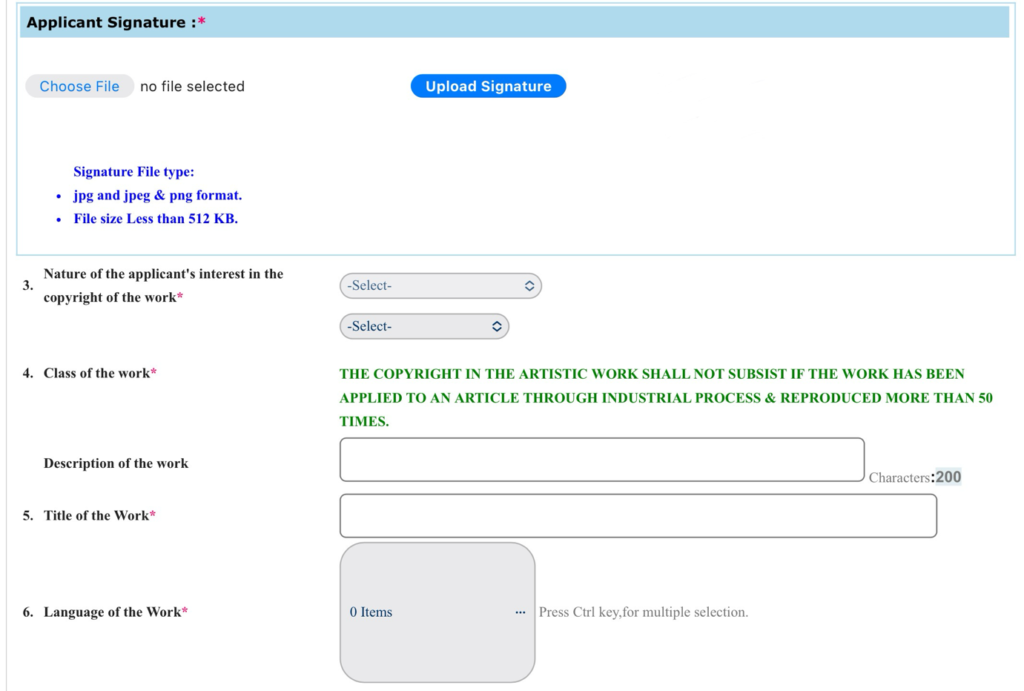
- Signature upload – You have to upload your digital signature (scanned) in JPG/JPEG/PNG format only, not bigger than 512 KB. This signature is needed for legal confirmation.
Section 3 to 6 – Nature of Your Interest in the Work, Class, Description, Title, language.
Here you select your relationship to the work:
- Author – you created the work yourself.
- Owner – you bought or inherited the rights from the author.
- Assignee – the author legally transferred the copyright to you.
- Legal heir – you inherited it from someone who passed away.
Class of work – This is the type of work you’re registering. It can be:
- Literary – books, poems, software, scripts
- Artistic – paintings, drawings, logos, designs
- Musical – music composition, notes
- Dramatic – plays, choreography
- Cinematograph film – movies, documentaries
- Sound recording – songs, podcasts, audio recordings
After you have selected the class of work, you have to:
- Describe the work briefly, max 200 words.
- Give the title of the work, eg, if I have written a book the title of the book is “Under the Moon”
- Mention the language(s) it’s in.
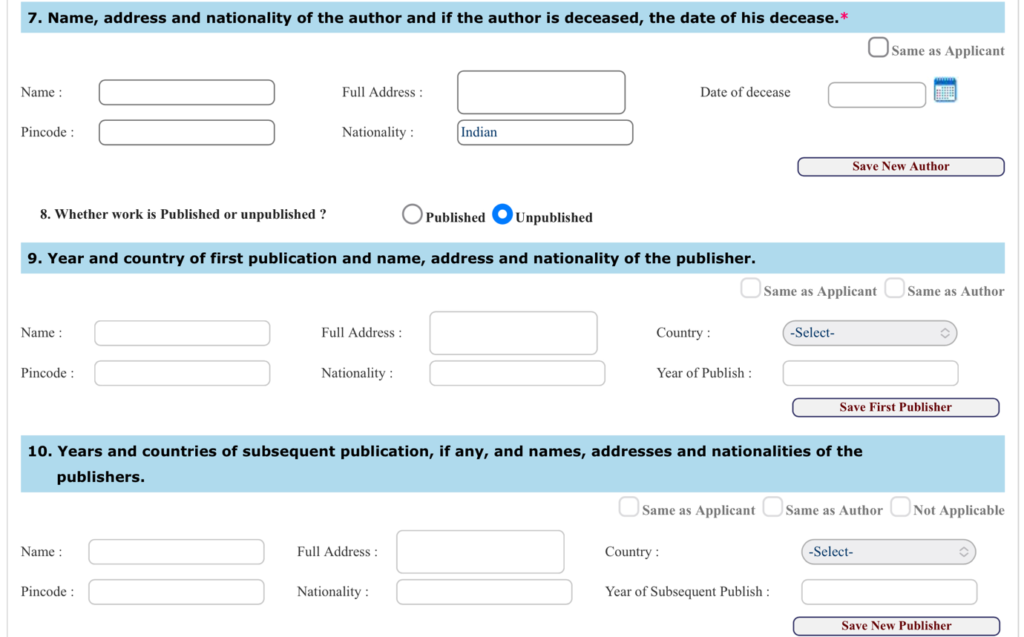
Section 7 – Author’s Details
If the author is different from the applicant, give:
- Author’s name, address, pincode, nationality.
- If the author has passed away, mention the date of death.
- If you are the author, you can tick “Same as Applicant” to avoid re-entering details
Section 8 – Published or Unpublished
- Published – the work has been released to the public (book launch, posted online, broadcast, etc.).
- Unpublished – the work has not been released to the public yet.
Section 9 and 10 – Publication Details
- First publication – Year, country, and details of the first publisher.
- Subsequent publications – Details of any later publishers, if the work was republished or updated.
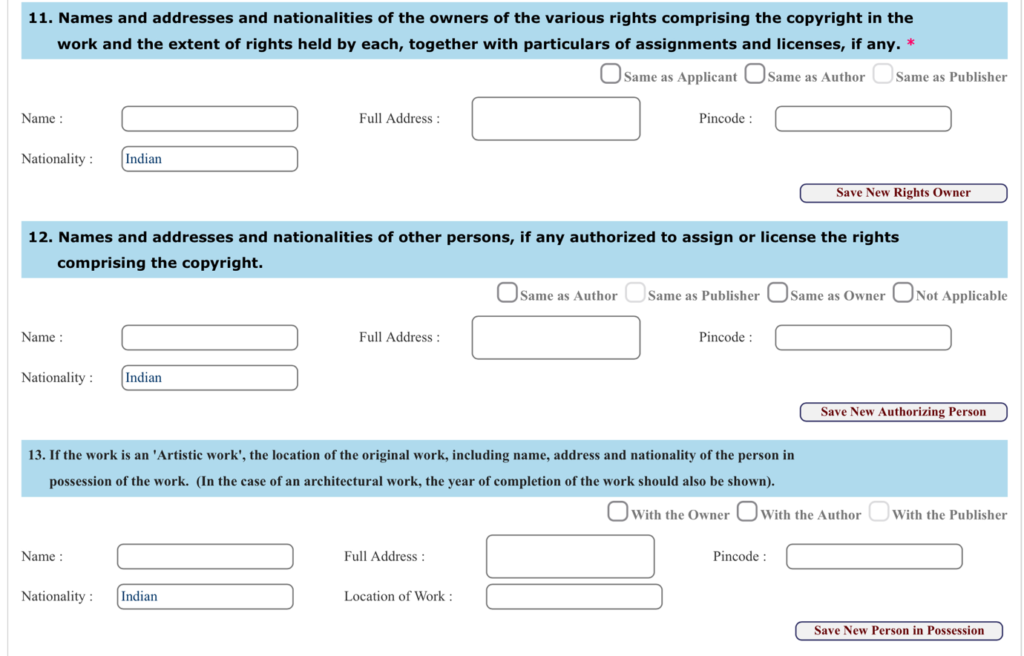
Section 11 – Rights Ownership
Sometimes, copyright rights are split — for example, one person owns the publishing rights and another owns adaptation rights.
- List all owners of different rights, their addresses, and nationalities.
- Mention their share of rights and whether they have assigned or licensed them.
Section 12 – Other Authorised Persons
- If someone is authorised to assign or license the copyright on your behalf (like an agent or lawyer), give their details.
Section 13 – Location of Original Work
- Artistic works only
- If it is any kind of artistic work, such as a painting, sculpture, or any work that falls under the category mentioned above, you have to give the name, nationality, and address of the person holding the original copy.
- This could be you, the publisher, or a gallery if it owns the original copy.
Section 14 – Trademark Certificate (Artistic works only)
- If your artistic work will be used for goods or services (like a logo or packaging design), you need a certificate from the Trademark Registrar confirming no conflict. You can get it by filing TC or TC-60 form in trademark.

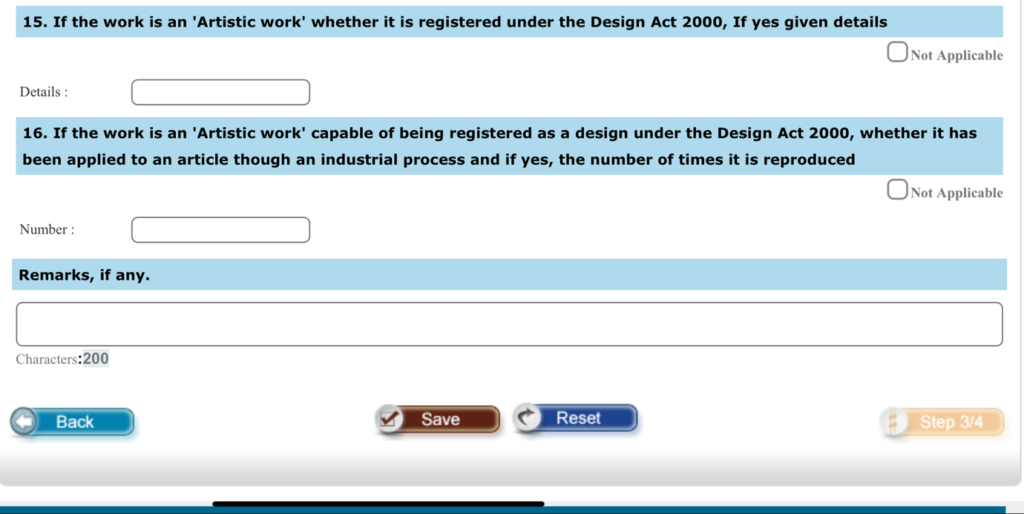
Section 15 – Design Registration
- If the artistic work is registered under the Designs Act, 2000, mention those details, or check the not applicable box.
Section 16 – Industrial Reproduction (Artistic works only)
- If your artistic work has been reproduced more than 50 times by an industrial process (e.g., printing a logo on hundreds of products), mention it here.
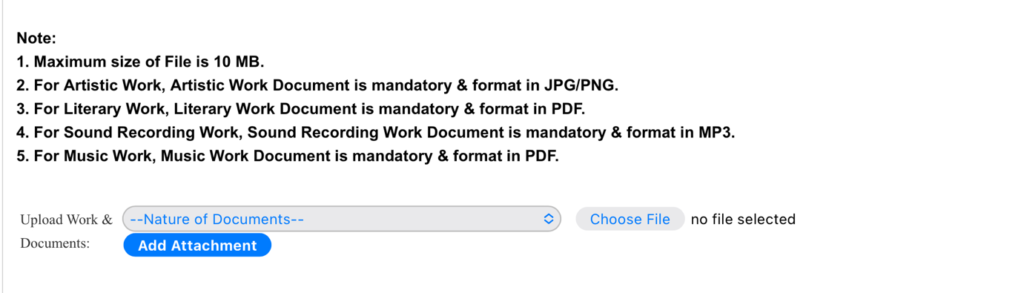
Document Upload Rules
- Max file size: 10 MB
- File format depends on type of work:
- Artistic work – JPG/PNG
- Literary work – PDF
- Sound recording –MP3
- Music work – PDF
STEP 4. Statement of further Particulars
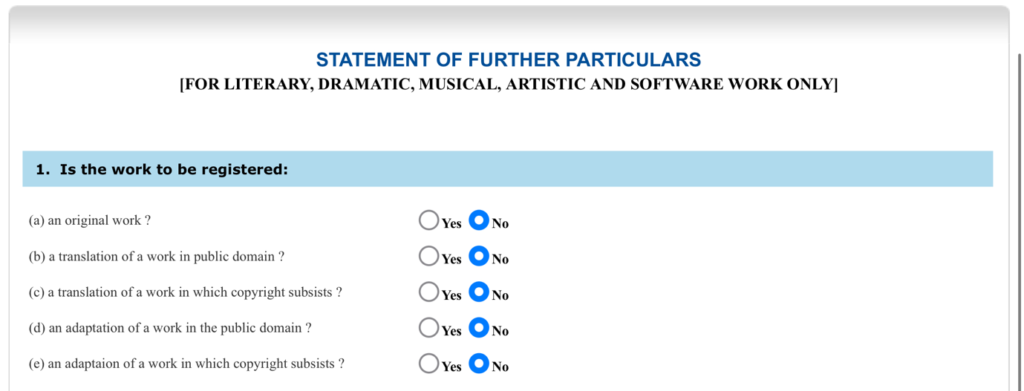
Section 1 – Is the work to be registered:
You answer Yes or No to each question:
- Original work – Is your work completely original, created by you without copying?
- Translation in public domain – Is your work a translation of something that is not under copyright anymore i.e public domain
- Translation of copyrighted work – Is it a translation of a work that is still under copyright i.e do you need specific permission from the author/owner?
- Adaptation in public domain – Is it an adaptation of a public domain work e.g., modernising Shakespeare?
- Adaptation of copyrighted work – Is it an adaptation of something still protected by copyright that requires permission?
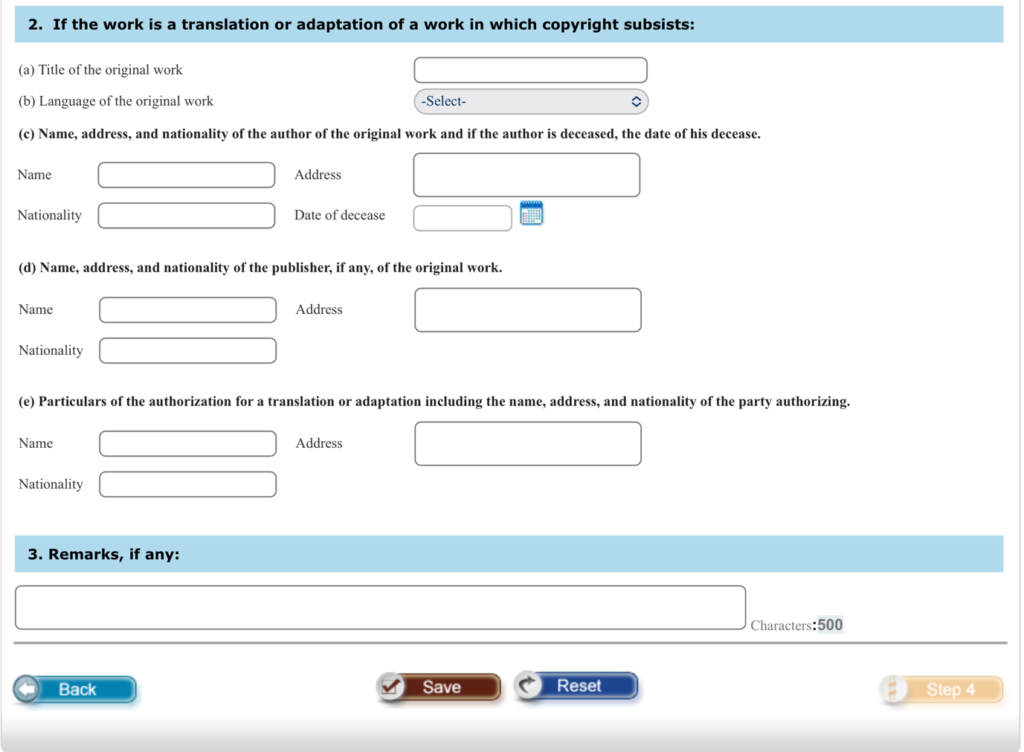
Section 2 – If your work is a translation or adaptation of a copyrighted work:
You must provide:
- Title of the original work
- Language of the original work
- Name, address, nationality of the original author/date of death if applicable,
- Same as above for the original publisher as well as authorisation for translation or adaptation.
STEP 5. Payment details
- Copyright Registration Fees
| Type of Work | Registration Fee (₹) |
| Literary, Dramatic, Musical, or Artistic Works | ₹500 per work |
| Cinematograph Films | ₹5,000 per work |
| Sound Recordings | ₹2,000 per work |
| Software (Computer Programs) | ₹5,000 per work |
Application Acknowledgment and Tracking
Once the application is submitted, the system instantly generates a Diary Number. This acts as proof of submission and enables applicants to track the status online. The Diary Number is essential for all future references and correspondence.
There is also an objection period of 30-day, this opens your work to public as a chance to raise objections on why your work should not be given copyright.
Scrutiny by the Registrar
If there is no objections then during the waiting period. The Registrar will review the application and documents to identify any discrepancies or errors.
In case an objection is filed, the Registrar will conducts a hearing and considers all evidence and submissions.
- If objections are received:
- Both the applicant and the objecting party will be informed.
- A hearing will be arranged to address the dispute.
- Hearing and Resolution:
- In the hearing, both parties present their arguments and evidence based on which the Registrar decides.
- If the objection is settled in favour of the applicant, the registration process proceeds.
Copyright Registration Certificate
The whole process takes 2-3 months, depending on any objections, proper documentation, timely responses to the raised objections, and adherence to procedural requirements are important to avoiding unnecessary delays or rejection but registration make sure of legal rights, especially for enforcement and damages claims, although copyright automatically exists upon creation. Once the application is approved, the Registrar of Copyrights will issue a Copyright Registration Certificate. The certificate acts as legal proof of ownership and is admissible in court as prima facie evidence.
CONCLUSION
Indian copyright law is not only meant to safeguard creativity but to promote it. By protecting a large variety of works—ranging from books and music compositions to architectural designs and computer software codes— the law ensures that creators can focus on their creativity without constantly fearing loss or misuse.
The concept of registering a copyright may be perceived as an administrative burden, but it is a simple procedure with long-term advantages. Especially in the case of disputes, negotiations of licensing or contracts and also acts as a deterrent against potential infringers. More importantly, it affirms the value of your work in the public record and serves as prima facie evidence in court in case of any dispute. While protection begins the moment your work takes a tangible form, registration is a solid step that transforms your creative work into a recognised legal property with proof. For creators in today’s accelerated and networked world, copyright registration is not merely symbolic – it is strategic.
REFERENCES
Berne Convention for the Protection of Literary and Artistic Works, 1886 (Berne Convention)
Copyright Office, India, FAQ: Is it necessary to register a work to claim copyright?, – https://copyright.gov.in/frmfaq.aspx
Copyright Protection in India- Overview and Recent Developments https://intellectual-property-helpdesk.ec.europa.eu/news-events/news/copyright-protection-india-overview-and-recent-developments-2022-03-02_en
Copyright Office, India, https://copyright.gov.in/UserRegistration/frmNewUser.aspx
Copyright Office, India, https://copyright.gov.in/frmFeeDetailsShow.aspx
A HAND BOOK OF COPYRIGHT LAW https://copyright.gov.in/documents/handbook.html
The Copyright Act 1957, Section 13.
The Copyright Act 1957, Section 14.
The Copyright Act 1957, Section 48.
The Copyright Act 1957, Section 51.